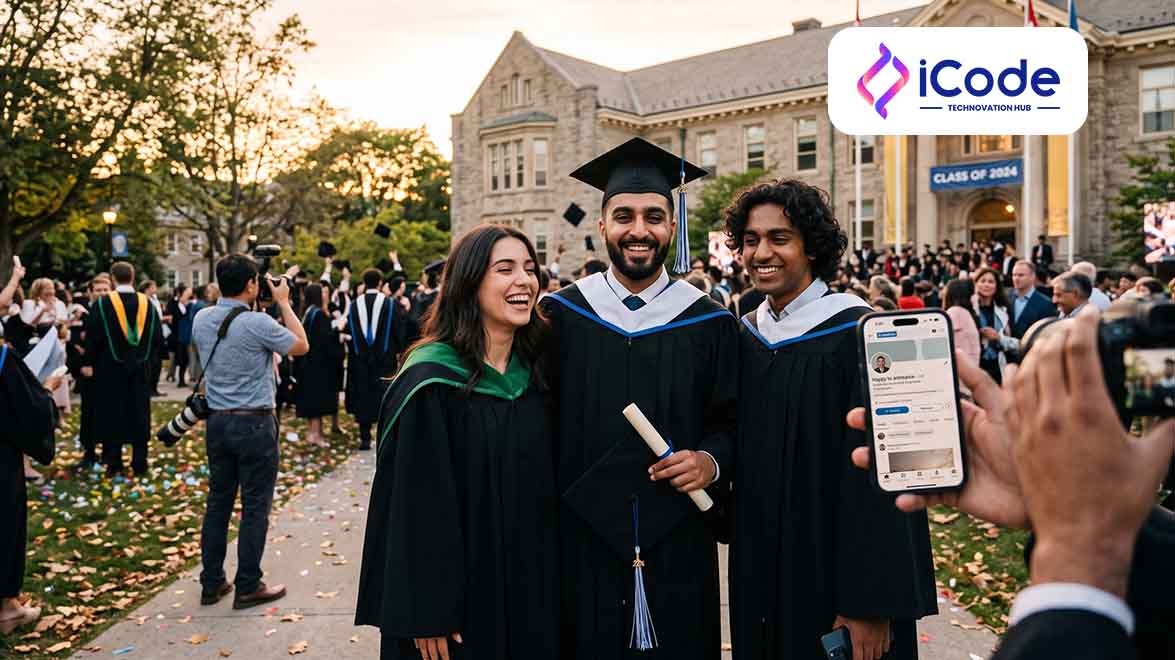
Results day ends. Convocation photographs get uploaded. LinkedIn slowly fills with “Happy to announce…” posts.
Then the questions begin.
“Where are you working?”
“Have you started applying?”
“What’s your plan now?”
For Engineering students, the conversation usually feels straightforward.
For many Commerce and Arts graduates, it doesn’t.
Some start preparing for bank exams. Some think about higher studies. Others begin applying for jobs that don’t really excite them because they believe those are the only options available.
The IT industry barely enters the conversation.
Not because they’re uninterested.
Because they’ve already convinced themselves they don’t belong there.
That’s a belief thousands of students still carry.
And it’s one that’s becoming less true every year.
The Industry Changed While Most People Were Looking Somewhere Else
Ten years ago, getting into IT without an Engineering degree wasn’t easy.
Companies mainly hired people who had already spent years studying programming. If you weren’t from a technical background, there weren’t many opportunities to catch up.
Things don’t work quite like that anymore.
Technology has found its way into almost every business. Retail stores depend on websites. Hospitals rely on software. Schools use digital platforms. Restaurants accept online orders. Even small local businesses now need websites, online marketing, and customer management systems.
As technology became part of everyday business, companies realised they needed different kinds of professionals, not just programmers.
That’s why today’s IT teams include developers, software testers, UI/UX designers, digital marketers, SEO specialists, content creators, business analysts, and many others.
Not all of them studied Computer Science.
Degrees Start Careers. Skills Build Them.
Ask someone who’s interviewed fresh graduates for a few years and they’ll probably tell you the same thing.
Very few interviews begin with your marksheet.
Recruiters usually become interested when you start talking about what you’ve actually built.
Maybe it’s a website.
Maybe it’s a design prototype.
Maybe it’s a digital marketing campaign.
Maybe it’s a testing project where you found problems others missed.
Those conversations matter because they tell employers something a degree never can.
They show how you think.
That’s one reason hiring has gradually shifted towards practical skills. Companies still value education, but they also know that two graduates with the same degree can have completely different levels of ability.
Commerce Students Already Bring Useful Skills
Commerce students often think they’re starting from zero.
They’re usually not.
Think about what Commerce teaches.
Understanding businesses.
Analysing numbers.
Making decisions based on data.
Looking at problems from different angles.
Those abilities fit surprisingly well into several technology careers.
Digital Marketing is an obvious example.
Growing a business online isn’t simply about posting content. It involves understanding customers, measuring campaign performance, analysing reports, and improving results over time.
Commerce students often find themselves comfortable with that way of thinking because they’ve already been exposed to business concepts throughout college.
The same goes for Software Testing.
Finding mistakes before customers do requires patience, observation, and logical thinking.
Those qualities matter every single day.
Arts Students Have Something Technology Can’t Teach
There’s a common misunderstanding that IT is mostly about writing code.
Spend a day inside a software company and you’ll realise how incomplete that picture really is.
Every successful app starts long before developers begin writing code.
Someone studies how users behave.
Someone decides where buttons should appear.
Someone writes the content.
Someone thinks about colours, layouts, and navigation.
In many cases, those people come from creative backgrounds.
Arts students often develop communication skills, storytelling, psychology, design thinking, and creativity throughout their education.
Those aren’t “extra” skills anymore.
They’re becoming essential in careers like UI/UX Design, Content Marketing, SEO, Social Media Marketing, and Product Design.
Technology has become more human.
That means human-centred skills matter more than ever.
The Biggest Challenge Usually Isn’t Coding
It’s hesitation.
Many students spend months wondering whether they should even try.
Ironically, every developer they admire once opened their first programming tutorial without understanding much either.
Nobody begins with experience.
The difference is that some people decide to start before they feel completely ready.
Learning today isn’t difficult because resources are missing.
It’s difficult because there are too many.
One video recommends Python.
Another says JavaScript.
A third insists AI has changed everything.
Before long, students spend more time deciding what to learn than actually learning.
That’s where structured guidance becomes valuable.
Learning from random videos and online resources can help you understand the basics, but moving from “I know something” to “I can build something” requires a proper learning path.
This is where choosing an IT training institute plays an important role. It help beginners understand what skills are actually needed, practise through guided projects, and avoid spending months learning things that may not help their career goals.
For students from Commerce or Arts backgrounds especially, having mentors, a structured curriculum, and practical exposure can make the transition into IT much smoother.
Choosing the Right Path Matters More Than Following Trends
One of the biggest strengths of the IT industry is its variety.
Some people genuinely enjoy solving technical problems and become Full Stack Developers.
Others enjoy understanding users and naturally move towards UI/UX Design.
Students interested in branding and communication often discover exciting careers in Digital Marketing.
Those who enjoy analysing systems and finding problems frequently succeed in Software Testing.
The goal isn’t to choose the most popular course.
It’s to choose one that matches how you naturally think and work.
Experience Always Leaves a Better Impression
Certificates certainly have value.
But projects tell a much bigger story.
A recruiter may forget the list of online courses you’ve completed.
They rarely forget a candidate who confidently explains how they built a website, designed an interface, fixed a difficult bug, or improved the performance of a campaign.
Practical work builds confidence.
And confidence usually comes from doing, not simply reading.
Learning with the Right Guidance
Starting something new always feels easier when someone helps you find the right direction.
That’s exactly why many Commerce and Arts graduates choose structured training instead of trying to learn everything on their own.
At iCode Technovation Hub in Nagercoil, students from non-technical backgrounds begin with the basics and gradually build practical skills through real-time projects, guided learning, and industry-focused training. Whether the goal is Full Stack Development, UI/UX Design, Digital Marketing, or Software Testing, the emphasis stays on becoming job-ready rather than simply completing another course.
Along with technical learning, students receive interview preparation, career guidance, and placement support, helping them step into the IT industry with confidence.
Because in today’s hiring market, your degree introduces you.
Your skills are what open the door.