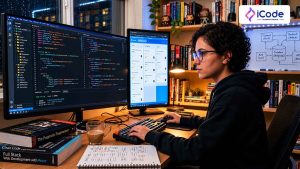
A few months ago, I was talking to a guy who wanted to get into software development. He’d already watched a lot of videos, saved a few courses, even installed a code editor on his laptop. But he still hadn’t started.
I asked him what was stopping him. He said, “I didn’t study Computer Science.” Just the feeling that he’d already missed his chance. For some reason, a lot of people think every programmer followed exactly the same path. School. College. Computer Science degree. Job.
That’s true for some people. Not for everyone.
Nobody asks where you learned your first “Hello World”
Think back to the first time you learned to ride a bicycle. Nobody asked where you learned. Nobody cared. They only cared whether you could ride it without falling off.
Programming feels a bit like that after a while. At the beginning, everyone worries about where they’re learning from. Six months later they’re more interested in getting their code to work. The conversation changes.
Most people don’t know as much as you think
One thing that surprises beginners is this. They imagine everyone else knows exactly what they’re doing. Then they join a class or start talking to other learners and realise everyone gets stuck.
Someone can’t fix an error. Someone else forgets a semicolon. Another person spends half an hour trying to work out why nothing is showing on the screen. That’s just part of learning.
It doesn’t matter whether you’re eighteen or thirty-eight.
Building something teaches you more than reading about it
I know people who’ve watched programming tutorials for months. Hours and hours of videos. Ask them to build something from scratch and they don’t know where to begin. Then I’ve met people who built a tiny calculator, a to-do list, or a basic website during their first few weeks.
Those projects weren’t perfect. Some looked terrible. Some barely worked. But they learned far more by trying than by watching someone else write code. That’s probably the point where confidence starts growing.
Not when everything works. When you realise you can eventually fix things that don’t.
It’s okay to start small
A lot of beginners make life difficult for themselves. They decide they’re going to learn five different things at once.
- Programming.
- AI
- Cybersecurity
- UI design
- Digital marketing
A week later their notebook is full. Their head is full too. If websites interest you, start there and find a front end development course in Nagercoil is enough to keep most beginners busy for quite a while. You don’t have to plan your entire career before writing your first line of code.
The internet makes people compare themselves too much
This happens all the time. You finish your first small project. Then you open YouTube. Someone’s building an online shopping website in twenty minutes. Another person is creating an AI tool. Someone else is talking about getting a six-figure salary.
It’s easy to sit there thinking, “I’m miles behind.” Maybe. Or maybe you’re just comparing your first month with someone else’s tenth year. That’s a much fairer way to look at it.
A degree helps. It’s just not the whole story.
If you already have a Computer Science degree, great. You’ll probably have a good foundation. If you don’t have one, that doesn’t mean you can’t learn.
I’ve met people who studied commerce, mechanical engineering, mathematics, English literature… and later ended up working in tech. None of them woke up one morning knowing how to code.
They learned little by little. The same way everyone else does.
Learning doesn’t stop after the course
One thing people don’t always realise is that nobody finishes learning programming. You complete one course. A few months later something new comes along. A different framework, a new tool, another language. That’s normal.
Technology changes all the time. The people who stay in the industry aren’t the ones who know everything. They’re usually the ones who don’t mind learning something new every now and then.
Pick something that feels useful
Not everyone wants the same job. Some people enjoy designing websites. Some like writing code behind the scenes. Others discover they enjoy creating WordPress websites or working with digital marketing teams.
That’s why it’s worth choosing a course that matches what you’d actually like to do instead of picking whatever happens to be popular.
Some students start with a WordPress Website Development Course because they want to freelance. Others move into a web app development course because they enjoy building complete applications.
There’s no single route that works for everybody.
So… do you need the degree?
If someone asked me that today, I’d probably answer with another question. “What are you waiting for?” If the answer is, “I’m waiting until I have the perfect background.” You’ll probably be waiting for a long time.
Most people working in software didn’t start because they felt completely ready. They started because they got curious.
Then they kept going.
If you’re looking for Job Oriented IT Courses in Nagercoil, iCodeLearning gives beginners a place to start without expecting them to know everything already.
Nobody walks into their first programming class knowing exactly what they’re doing. That’s completely normal. The important part is walking in. Everything else comes one step at a time.