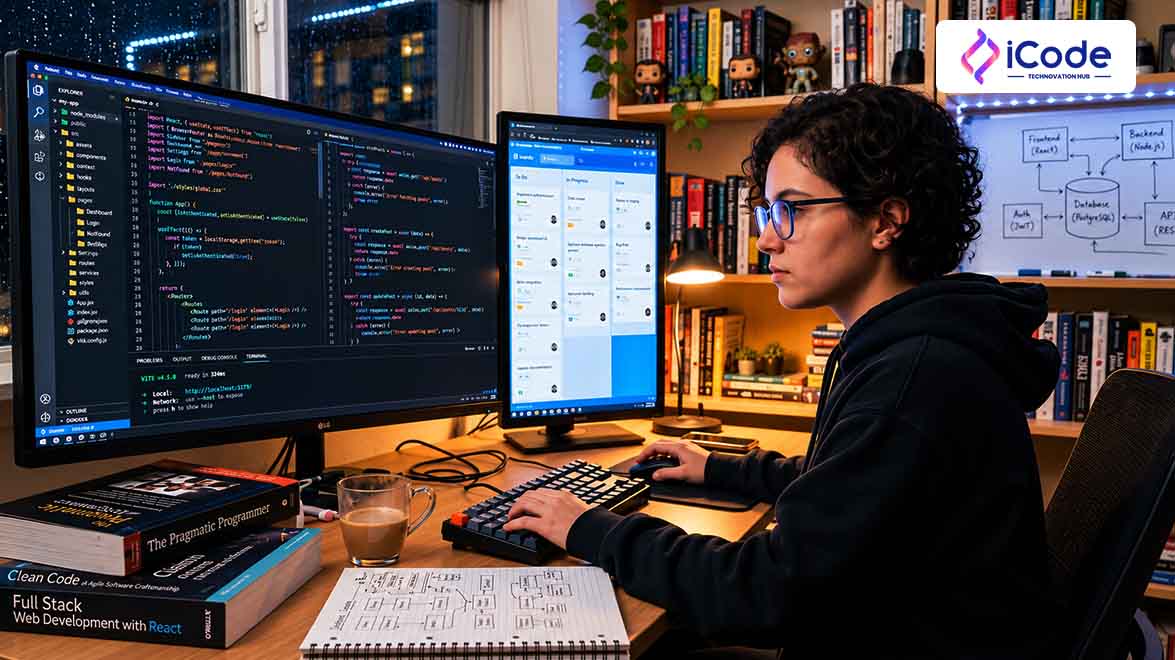
More often than not, a newbie can expect to spend about 3 to 6 months getting the foundational knowledge of full stack development. In order to learn how to create more complicated projects, an individual should expect to spend an additional 6 to 12 months on the subject, plus another six months of time for practical experience before starting to apply for junior developer positions.
The above numbers depend greatly on your previous knowledge of the topic as well as the frequency of the study process.
Why Learning Full Stack Development Takes Time
There is no shortage of short courses promising to teach full Stack and digital marketing course in a few weeks. Some of them even suggest that all you need to do is sit through a couple of videos and obtain your certificates.
In reality, this is never the case.
Yes, it is possible to grasp the basics fairly quickly, but the process of becoming comfortable enough to actually create a website is a completely different story.
The distinction, in fact, depends on how you define learning.
If all you care about is grasping the concept of HTML, Python, SQL, Django, etc., then you can cover that in no time. However, if you are looking to create a website where one can register, log in, and submit information, then you definitely need to spend more time on the subject.
The first month may feel slower than expected
When you start learning full stack development, you may expect to begin with an actual website. Instead, the first few classes may involve basic programming.
You might learn about variables, conditions, loops, functions, and data types. None of these topics looks particularly exciting when you are starting out. You may even wonder how writing a small Python program has anything to do with building a website.
Later, the connection becomes clearer.
A website needs to make decisions. It needs to check information, repeat tasks, store details, and respond to what a user does. Those small Python concepts are used for all of that.
As you create your first-ever HTML and CSS layouts, you may find yourself creating only simple things: headings, images, colours, and sections for the site. These results may look pretty basic, but you should not worry, as this is only a part of the HTML and CSS training course.
The reason why skipping this stage could cause problems later on is that even if you feel comfortable clicking the buttons, you may not know how the code behind it works.
Learning the tools is only the beginning
Full stack development includes the following parts:
There is frontend, which refers to what the user sees, backend, which represents the coding behind the scene, and database, which stores files and information. In addition to these features, you also need to address API and security issues, among others.
For example, a student taking a Python Django Full Stack Course in Nagercoil may start with Python before moving into Django. After that, the student may learn how to create pages, connect forms, work with a database, and display information from the backend.
Each topic is manageable on its own. The challenge comes when you have to connect everything.
A registration page is a good example. Creating the page may be fairly simple. But once the form is submitted, the information has to reach the backend, be checked, and be stored correctly. Then the website needs to show an appropriate message to the user.
That one feature involves more than just designing a form.
You learn much more when you build something yourself
A person can finish a long list of tutorials and still feel unsure when opening a blank coding window.
This happens because following instructions is different from making decisions.
Once your instructor tells you, “Now build this file, copy this code, and execute the project”, you are sure of what to do next. However, when it comes to developing a tiny program without having been directed, you have to find a way to start.
This is the reason why it is important to do the projects.
You may design an uncomplicated blogging program, a school database, a course selection web page or a basic company website. The project does not need to impress anyone; it has to be something you can manage.
You should know where the information is kept, how pages communicate with each other, how users act with the site, and what happens in case something goes wrong.
A small task developed by yourself teaches you more than a big one using the scheme.
You will probably get stuck while working on it. A page may not load. A form may not save. The database may return an error. You may spend an evening trying to find one missing line.
That time is not wasted. You are learning how to solve the kinds of problems developers deal with regularly.
So, what is a realistic time frame?
For beginners, three months should be enough to learn basic ideas and create some simple web pages and applications.
However, those three months may not be enough for the person to be confident when developing a fully functioning application.
If the person has regular classes and practice, it may take six months to build acquired basics.
Some people will need longer. Someone who studies only once a week will probably progress differently from someone who spends time coding every day.
The number of months is not as important as what you can do by the end of them.
Can you create a page without copying the entire design from a video? Can you connect a form to a database? Can you explain how your login system works? Can you find the reason for a simple error?
These are better signs of progress than simply completing a syllabus.
Practice outside class makes a big difference
Two students may attend the same course, listen to the same trainer, and receive the same notes. Still, their progress may be very different.
One may practise after every class. The other may wait until the next session.
You do not need to spend the whole day coding. Even regular practice for an hour can help. One option is to take the examples provided in class and modify them, or you could think of a new characteristic to add.
The key point is to not be a passive learner.
If you learned how to make a form, create a different form.
If you learned how to retrieve information from a database, consider ways that you would display a different type of information.
If you learned about how a login page operates, you should think about what would happen if the password entered is wrong.
Small experiments make the subject easier to remember.
They also reveal the gaps in your understanding. That is useful because you can ask about those gaps instead of assuming you have understood everything.
You do not need to learn every technology
The number of tools used in web development can be overwhelming.
You may hear about Python, Django, JavaScript, React, Node.js, PHP, Laravel, MySQL, PostgreSQL, Git, APIs, and many other technologies. It is easy to think that you need to learn all of them before you can call yourself a developer.
You do not.
Start with one sensible learning path.
If you are planning to undergo a MERN Full Stack Course in Nagercoil, then your technology journey will be different from that of someone who is doing Python and Django. These two classes deal with frontend and backend work but use different programming languages and frameworks.
In either case, you do not need to learn everything at once.
You will be better off understanding one set of tools thoroughly instead of just learning a little bit about many technologies without gaining the ability to build something out of them.
Once you know how programming works and what a web application is like, it will be easier for you to learn another framework.
What about getting a job after the course?
Even if you finish the course, it does not mean that you are prepared for every kind of developer position. You must practice, construct some projects, and find out how to explain what you do.
In case of entry-level positions, you are not believed to be aware of all complicated ideas, but basic comprehension of the profession is required.
If you built a student management application, for example, you should be able to explain how you created it and what each major part does. You should not have to depend entirely on the person who taught you.
Students comparing Job Oriented IT Courses in Nagercoil should look beyond the course duration. It is worth checking whether the training includes practical assignments, project work, coding practice, and time to ask questions.
A short course with proper practice may be more useful than a longer course where you only listen and take notes.
The answer depends on what you want to do
If your intention is to learn the fundamentals, you may progress in a matter of months.
If you aim to create complex apps and find a job as a junior developer, be prepared to spend more time applying your knowledge by working on assignments. Some people may find six months to be a good starting point, but this isn’t a strict limit
You may understand one topic quickly and struggle with another. That is normal.
Full stack development is a wide subject, and there will always be something new to learn. Even working developers continue learning because tools and project requirements keep changing.
Instead of worrying about finishing within an exact number of months, focus on becoming able to do more things without help.
Start with a simple program. Then build a webpage. Connect it to a database. Add a login page. Fix the errors. Improve the project.
That is how the skill develops, one working feature at a time.