The last exam gets over. For a few days, life feels lighter. No homework. No tuition. No revision.
Then the questions begin. “What are you going to do after 12th?”
Some students answer without thinking. Others are still figuring it out.
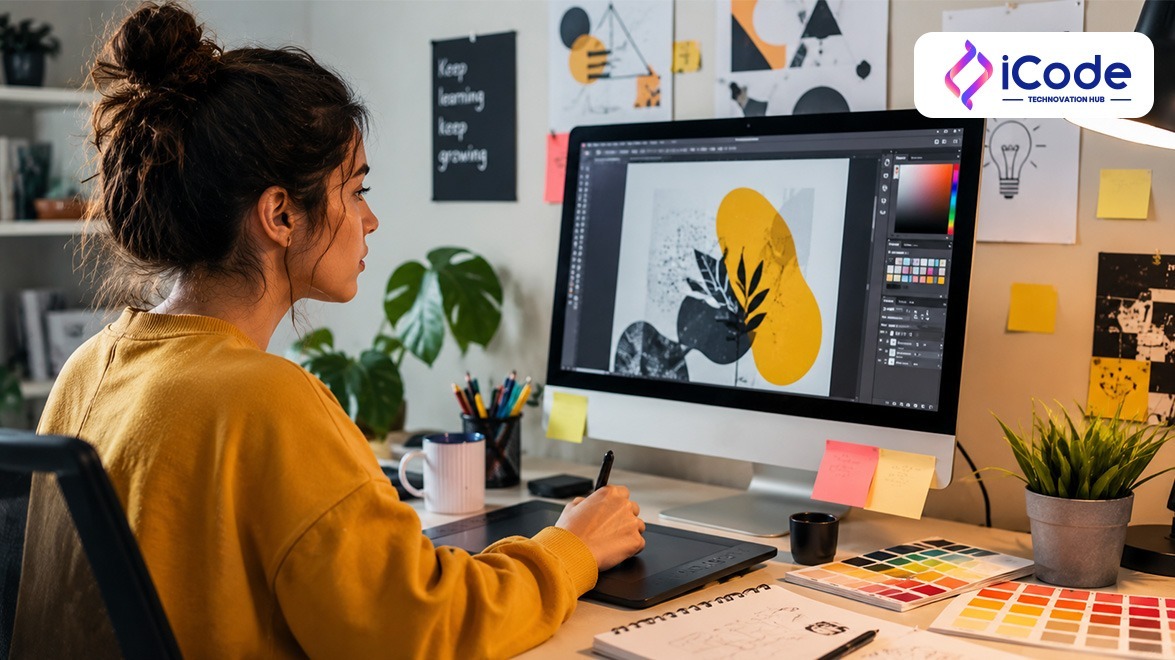
If you’ve always been the person who likes making posters, editing photos or creating social media designs for fun, there’s a good chance you’ve already thought about graphic design.
Don’t worry if you can’t draw like an artist. Most designers don’t start out that way. They improve by creating, making mistakes and trying again.
It usually starts as a hobby
Very few designers grow up saying, “I’m going to become a graphic designer.” For most people, it starts much more casually. Someone asks them to make a birthday invitation. A friend needs a college event poster. They try designing a logo just to see if they can.
Then they realise they actually enjoy it. One small project turns into another, and before long they’re spending hours experimenting with colours, layouts and fonts without noticing the time.
That’s how many design careers begin. Not with a big plan. Just with curiosity.
Don’t worry if your first designs look ordinary
This is probably where many beginners lose confidence. They compare their first poster with work created by someone who’s been designing for ten years. That never ends well.
Every designer has old projects they’d rather hide today. That’s completely normal. Getting better doesn’t happen in one week.
It happens one design at a time.
Every mistake teaches something. You slowly notice better colour combinations. You start placing text more neatly. Your layouts become cleaner without even thinking about it.
One day you open an old file and wonder, “Did I really make this?” That’s usually a sign you’re improving.
Software is only one part of the job
Many students think learning Photoshop is the biggest challenge. It isn’t. Anyone can learn where the tools are after enough practice. The harder part is understanding why one design grabs your attention while another disappears without you even noticing.
Open Instagram for a minute and keep scrolling. Every now and then, something makes you stop. It could be the colours, the photo, the layout or even the way the text has been arranged. You probably don’t think about those things while you’re scrolling, but a designer has.
Where should you learn?
There are thousands of free videos online, and they’re useful when you want to learn one small trick. Learning an entire skill that way is much harder. One video teaches one method. The next video teaches something completely different.
After a while, it all starts to feel a bit confusing. One video tells you to design something one way, and the next video suggests something completely different.
That’s one reason students often prefer learning through a graphic design course. The lessons follow a proper order, there’s someone to guide you when you’re stuck, and you spend more time creating real projects than jumping between random tutorials.
Quite a few students also go for a graphic design and video editing course. It makes sense because businesses rarely need just one type of content anymore. One day it’s a social media post, the next it’s a short video or a YouTube thumbnail. Having both skills gives you a little more flexibility when you’re looking for internships or your first job.
Build your own work while you’re learning
One mistake many beginners make is waiting until they’ve finished a course before creating anything on their own. There’s no reason to wait.
Pick a local restaurant and redesign its menu. Create a poster for a college event. Make a logo for an imaginary business. Design a few Instagram posts for your favourite clothing brand.
Nobody has to ask you to do these projects. They’re simply good practice. After a few months, you’ll have something much more valuable than you realise.
You’ll have a portfolio.
When companies interview a graphic designer, they usually want to see what that person has created. A portfolio gives them a much better idea of your skills than a list of software names.
There isn’t just one place where designers work
A lot of students think graphic designers only work in advertising agencies. That hasn’t been true for a long time. Today you’ll find designers in software companies, marketing agencies, printing firms, YouTube channels, online stores and startups.
The nice thing about this career is that you’re not limited to one industry. Almost every business needs someone who can create good designs.
As your experience grows, you can also choose the kind of work you enjoy most instead of doing everything.
Learning one more skill can help
Graphic design is a strong skill on its own. But many designers don’t stop there. Some learn branding. Some move into motion graphics. Others become interested in websites and mobile apps.
After working on graphics for a while, some people become curious about websites and mobile apps.
That’s usually where a UI UX Design Course comes in. You start looking beyond colours and layouts and begin thinking about how people actually use a website. It opens the door to a different kind of design work, and plenty of graphic designers enjoy learning it once they’re comfortable with the basics.
Keep looking, even when you’re not designing
Good designers have one habit in common. They notice things. They quietly ask themselves simple questions.
“Why does this look good?”
“Why is this easy to read?”
“What would I change?”
Over time, you start noticing good design without even trying.
One day you’ll be standing in a supermarket looking at two biscuit packets and wondering why one looks better than the other.
Or you’ll be scrolling through YouTube and catch yourself looking at the thumbnail instead of the title.
It sounds strange at first, but it happens to almost everyone who spends time learning design. After a while, you stop looking at things the way everyone else does.
Finding the right place to learn
There’s nothing wrong with learning from YouTube. Most designers still do.
The problem is that you’re learning on your own. If something doesn’t make sense, you either spend another hour searching for answers or simply move on.
That’s why many students eventually decide to learn in a classroom where they can ask questions, work on proper projects and get feedback along the way.
If you’re planning to learn in Nagercoil, iCodeLearning is one place worth looking at. The Graphic Design Course in Nagercoil is built around practical work rather than only software lessons. Later, if you want to move into websites and apps, there’s also a UI UX Design Course, so you don’t have to start from scratch somewhere else.
Graphic design isn’t a career where you wake up one morning knowing everything. You learn something. You make something. Then you do it all over again.