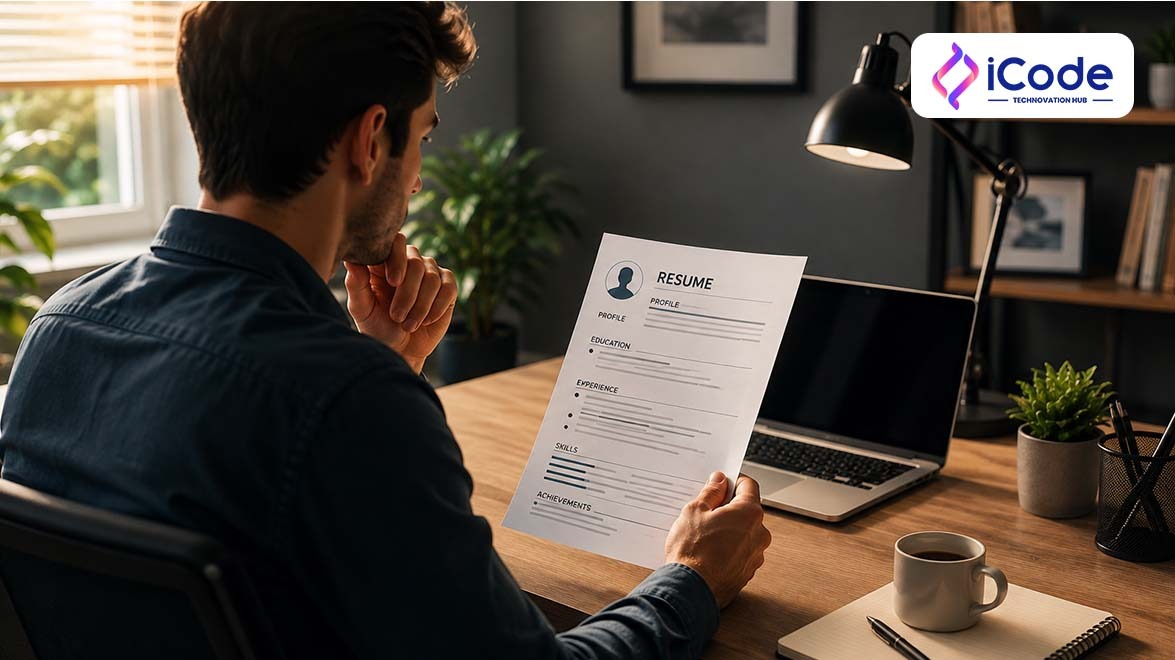
Rahul had everything he believed a company wanted.
- A degree?
- Good marks?
- A well-designed resume?
When campus placements began, he confidently applied for job after job. Every morning, he refreshed his email, hoping to see an interview invitation. Days turned into weeks, but his inbox stayed empty.
Confused, he showed his resume to his cousin, who worked as a software developer.
His cousin looked at it for less than a minute before asking a question Rahul had never thought about.
“If you were the recruiter, would you hire yourself after looking at this resume?”
Rahul didn’t answer immediately. Instead, he opened his resume again, this time through the eyes of an employer.
It’s a question every student should ask before sending their next job application.
Your Resume Is More Than Just a Document
Many students think a resume is simply a list of qualifications, skills, and achievements. They spend hours choosing attractive templates, changing fonts, and making everything look professional.
But recruiters aren’t impressed by colourful designs.
They’re looking for evidence that you can contribute to their team.
In most companies, recruiters spend only a few seconds scanning each resume. During those few seconds, they silently ask themselves one question:
“What makes this candidate different?”
If your resume looks exactly like everyone else’s, it becomes difficult to stand out.
Degrees Get You Noticed, Skills Get You Hired
A college degree is an important milestone, but it isn’t the finish line.
Imagine two fresh graduates applying for the same software development role.
The first candidate lists programming languages, communication skills, and software tools.
The second candidate mentions building a personal portfolio website, developing a small web application, contributing to a team project, or completing a software testing assignment based on real-world scenarios.
Who would you be more interested in interviewing?
Most employers would choose the second candidate because projects demonstrate what a person can actually do, not just what they claim to know.
Is Your Resume Telling Your Story?
Take a moment and read your resume from top to bottom.
Does it tell the story of someone who’s ready to work in the IT industry?
Or does it simply mention subjects you’ve studied?
A memorable resume reflects growth.
Maybe you’ve created a responsive website.
Maybe you’ve designed a mobile application’s interface.
Maybe you’ve managed a digital marketing campaign or tested an application to find bugs.
These experiences tell recruiters that you’re curious, willing to learn, and capable of solving problems.
That’s exactly what companies are looking for.
Don’t Fill Your Resume With Buzzwords
Many resumes include phrases like:
- Hardworking
- Quick learner
- Team player
- Good communication skills
There’s nothing wrong with these qualities.
The problem is that almost every resume says the same thing.
Instead of telling employers you’re a quick learner, show them.
Talk about a project you completed, a challenge you solved, or a new skill you taught yourself.
Real examples are always more convincing than generic descriptions.
Learning by Doing Makes the Difference
Reading books and watching tutorials can help you understand concepts, but practical experience is what builds confidence.
When you work on real-time projects, you learn how to solve problems, collaborate with others, and think like an IT professional.
These experiences also give you something meaningful to include on your resume.
That’s why choosing the right IT training institute in Nagercoil is an important decision for students who want to build practical skills instead of simply collecting certificates. The right learning environment helps you move beyond theory and prepares you for the challenges you’ll face in the workplace.
Interviews Become Easier When Your Resume Is Real
One of the biggest advantages of practical learning is confidence.
Imagine an interviewer asking,
“Can you tell us about a project you’ve worked on?”
If you’ve actually built a website, designed an interface, tested software, or created a marketing campaign, you won’t have to memorise answers.
You’ll simply talk about your experience.
You’ll explain the challenges you faced, how you solved them, and what you learned.
That’s the kind of conversation recruiters enjoy because it shows genuine understanding.
Keep Building, Keep Improving
No one starts their career as an expert.
Every professional developer, designer, tester, or digital marketer was once a beginner.
The difference is that they didn’t stop after earning a degree.
They kept learning.
They built projects.
They practised consistently.
And over time, their resumes became stronger because their skills became stronger.
Instead of asking, “How can I make my resume look better?” try asking,
“What can I learn today that will make me a better candidate tomorrow?”
That simple change in mindset can transform your career.
Final Thoughts
Before you apply for your next job, spend a few minutes reviewing your resume; not as a student, but as a recruiter.
Ask yourself honestly,
“Would I invite this person for an interview?”
If the answer isn’t a confident “yes,” don’t be discouraged. Every new skill you learn, every project you complete, and every challenge you overcome adds value to your professional journey.
If you’re looking for guidance to build those industry-ready skills, iCode Technovation Hub has become one of the best IT training institute in Nagercoil, helping students, fresh graduates, and career changers prepare for successful IT careers. Through beginner-friendly courses, real-time projects, expert mentorship, career guidance, and placement support, iCode focuses on turning learners into confident professionals who are ready to step into the industry.