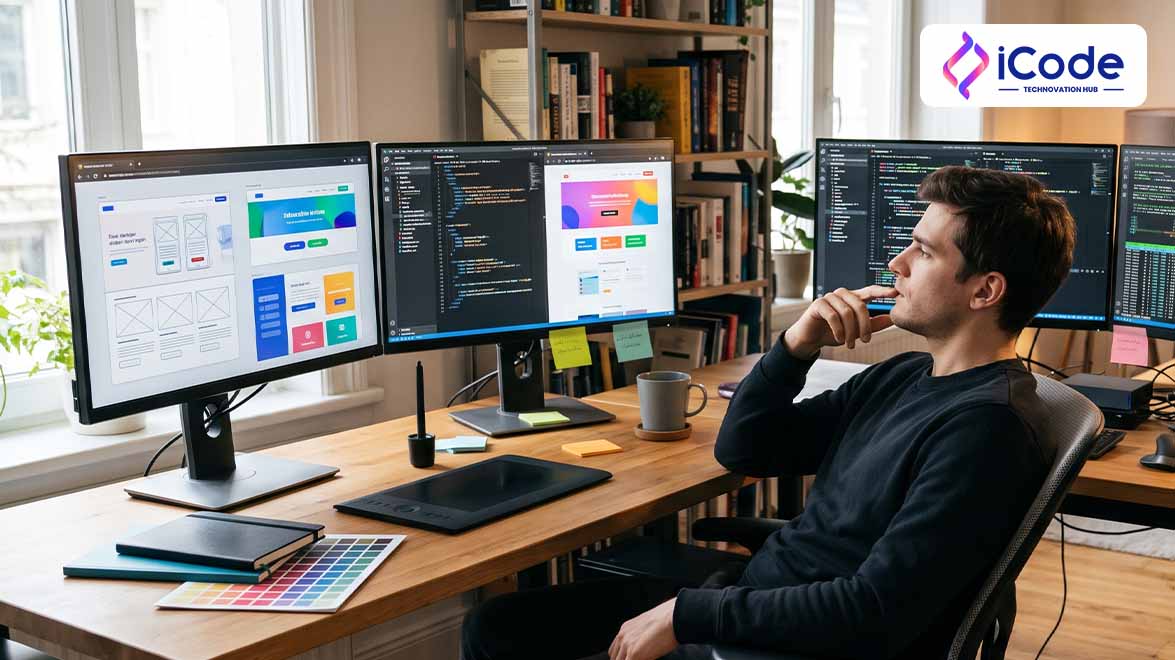
If you are interested to be a web developer, you must have heard about words like frontend, backend, and full stack. Moreover, if you are taking a Python web development course or considering a full stack program, you might be thinking about whether it is necessary to know everything for starting your career in web development.
Well, this is a good question. There are different types of tools, languages, and frameworks that might make it feel complicated.
The short answer? No, you don’t have to know everything before starting. However, having the idea about how frontend and backend work together would help you find more opportunities as you improve your skills in web developing.
First, What’s the Difference Between Frontend and Backend?
Whenever you browse any shopping site, you come across all the visuals and buttons that you use. All of that comes under the domain of frontend.
The frontend developers are responsible for creating these features; their tools include HTML, CSS, and JavaScript, among others. They also ensure that the website works on mobile and other devices.
The backend is another story: it involves customer accounts, ordering process, database, and communications between the application and the users.
For example, the button “Add to Cart” might be pressed, but there are many processes occurring simultaneously, including the recording of the bought product, its price, and the quantity desired.
Thus, it is clear that the interplay between the frontend and backend technologies allows us to achieve the desired outcome.
Can You Get a Job by Learning Only Frontend?
Definitely! Becoming a frontend developer does not necessitate any previous knowledge of back-end programming.
If you like the idea of creating page aesthetics and usability, going into frontend development should be a great opportunity.
Start by studying the basics of HTML and CSS, and then develop your skills in JavaScript.
After that, you can start learning other technologies like React JS.
If you are looking for structured education, consider joining a React JS course in Nagercoil, but be sure it is focused on the basics rather than specific technologies.
Lastly, don’t just keep watching countless tutorials but practice your knowledge as well by working on some personal project, for instance, building a working website with a business representative.
There will be difficulties associated with this process, but it is a common thing to encounter problems while coding.
What If You Prefer the Backend Side?
It may not be everyone’s taste to spend long hours tweaking layouts and colours as some would prefer to dabble with data and write application logic to learn the reason for things happening behind the scenes. If that’s your thing, you might want to think about backend development.
A good starting point would be Python, which will pave the way for you to work with Django once you master the language. Besides, you will need to obtain some knowledge about databases and how applications process requests and user data.
If you are ready to learn Python Django full stack development with practical training, it will help you structure your approach to obtaining the necessary skills.
Once you choose a respective direction to follow, be careful with practical work. It’s much more beneficial to understand how the code operates than to copy it from the tutorial giving no clue of whether it would work.
Is Learning Full Stack Development Worth It?
A full-stack developer is someone who works on both the front-end and back-end of a web application. For example, in case you are developing a reservation system, you will need to create web pages for users to choose a date, a back end for booking reservations, and a database with information. A full-stack developer understands how these different components come together.
Such knowledge will be useful when working on a team and completing some small projects by yourself.
A JavaScript full stack development course will cover JavaScript React as a front-end technology and Node.js as a back end example, along with databases and APIs.
However, keep in mind that knowing both front-end and back-end of development doesn’t mean that you should be perfect in both. Usually, developers are stronger in one of these areas, but they still can use their full-stack experience when necessary.
Moreover, it’s absolutely not obligatory to learn React, Angular, Django, Laravel, and Node.js all at once. Choose your technology stack and learn how to work with it properly.
What Should You Learn First?
This is where many beginners get confused. They compare course content, watch videos about programming languages, and constantly change their mind about what to study.
Instead, you should choose something to start with and give yourself time to understand it.
- Are you into website design? In this case, you can start with HTML, CSS, and JavaScript.
- Are you keen on programming logic? If you are, then Python would be a good choice for you followed by writing a few small applications.
- Do you want to learn how to work on whole applications? Then start with basic things and try to learn full stack development afterwards.
Complete several projects while doing this. Even simple apps like a task manager or a personal website would help you learn a lot about development.
Once you’ve created something, change it a little bit. For example, you can add an option, fix an error, or improve a page. You will learn much more this way than just receiving your certificates.
If you want to attend a Python full stack training institute that teaches full stack development using Python, make sure to find out what concrete things students are doing in the course.
What Do Employers Actually Want?
While it is important to know various programming languages, having just a list of technical expertise on your CV cannot assure the employer of your abilities.
Can you describe the working process of your program? Are you capable of bug solving and debugging? Do you understand the code you wrote? Are you able to think through problems without looking for a solution by someone else?
These features of you do matter.
You do not necessarily need to have a portfolio filled with complex applications in order to impress the employer. Few successful projects presented in the portfolio might be sufficient.
Also, you should not wait until you acquire all the knowledge you think is necessary in order to apply for a job, since there is always something new to be learned.
So, Do You Need Both?
Acquiring skills in both frontend and backend technologies will enable you to acquire a better insight into the field of web development; however, starting with either is advisable as sooner or later you will be able to master the other.
Don’t base your decision on a course on the number of technologies it covers. Consider your goals and interests, as well as the amount of hands-on experience you will gain.
To become a developer, you don’t need to know everything; you only have to master the fundamentals well enough to create something that you understand and keep on improving.